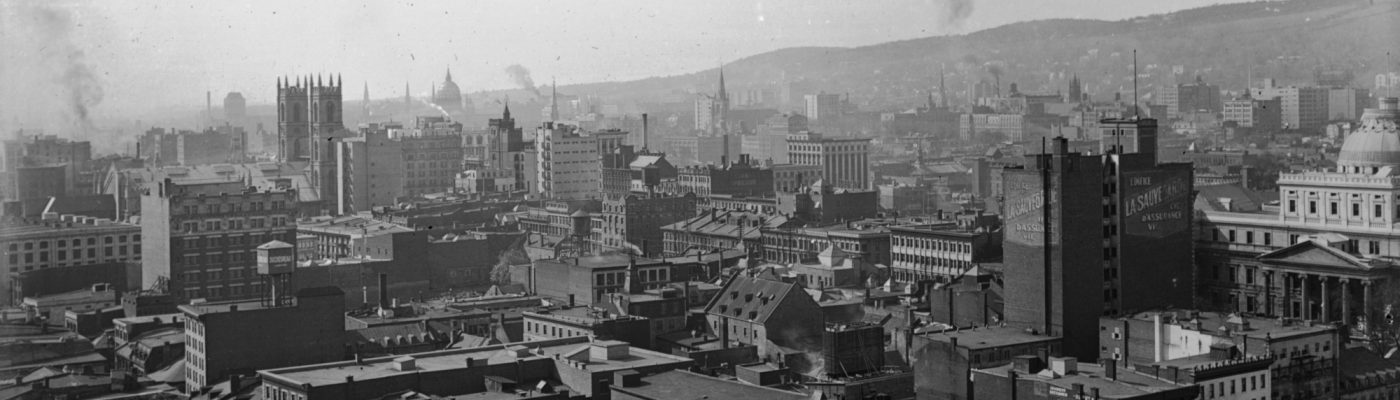
News of the German invasion of Poland reached Montreal in the early hours of 1 September in time for the morning papers and radio news. There was little surprise and, for many, relief that the waiting was over. There was also broad agreement that the British and French governments would gather their courage and redeem their guarantee to Poland. André Laurendeau’s recollection of the mood among his nationalist comrades was “horror at Hitler’s invasion of Poland, fear that the fighting would spread, the wish to avoid, if possible, taking any part in it ourselves” reflects the isolationism that motivated him and his friends.[1] On 4 September, Britain and France declared war. Paul Gouin and others from the Action Libérale Nationale fringe organized a rally to oppose Canadian participation. René Chaloult typified their view claiming that “French Canadians would rather fight in the streets of Montreal than fight in Europe.” The crowd roared its approval shouting “We won’t go” with rises of “It is the Jews and bankers that started it”. Retrospectively, Laurendeau described such meetings as “a lot of smoke and not much fire,”[2] but neither he nor outside observers knew what such rhetoric meant in 1939.
It was up to Ernest Lapointe, French Canada’s acknowledged leader, to balance his belief in the necessity of Canadian participation in the war with a message designed to placate his isolationist followers. During the debate on Canada’s declaration of war, on 10 September, he quoted from King George VI’s speech of 3 September in which the monarch declared that “the freedom of our country and of the whole British Commonwealth of nations” was at stake. “For the sake of all we hold dear and of world order and peace,” it was unthinkable that we should refuse Hitler’s challenge. Lapointe then repeated his agreement that “neutrality was impossible for Canada and that the dispatch of an expeditionary force was inevitable if the large majority of Canadians wanted one. Turning to face his Quebec colleagues he declared that:
He was authorized by his Quebec colleagues in cabinet… to say that we will never agree to conscription and will never be members and supporters of a government that will try and enforce it.[3]
Lapointe’s assurances, intended to appease the political class in Quebec, appeared to be successful but on 25 September Premier Maurice Duplessis, without consulting his cabinet or caucus, called an election seeking the endorsement of his protest against the Federal invasion of provincial jurisdiction under the cloak of the War Measures Act. Learning that political speeches must be cleared by the Dominion Censor before broadcast on Radio Canada, he declared that he would never submit to such tyranny.[4] Duplessis opened his campaign in Trois-Rivières, his home riding, on 5 October startling his audience with a statement that “a vote against him will be a vote for participation, assimilation, centralization and conscription.”[5]
Initially, Quebec Liberals feared Duplessis would win the election since it appeared that most voters were against participation in war.[6] Lapointe took up the challenge and began a campaign to defeat Duplessis based on the threat that if the Premier was re-elected he and his cabinet colleagues from Quebec would resign. They were, Lapointe argued, the guarantors of the pledge not to impose conscription and would continue in that role only if Duplessis’s “act of national sabotage is defeated.”[7] Forcing Quebec voters to choose between Lapointe and Duplessis changed the focus of the campaign, and on election day their provincial leader Adélard Godbout won seventy of the eighty-five seats in the legislature with fifty-four percent of the vote. In Montreal Anglo-Celtic and Jewish voters, who had supported Duplessis, joined the rest of the city as the Liberals swept all area ridings.[8]
Opposition to active participation in the war was not limited to French Canadian Nationalists. In Ottawa, isolationists including Mackenzie King’s key advisor O.D. Skelton continued to argue the case for neutrality or, after 10 September, the most limited participation possible. The CCF leader J.S. Woodsworth maintained his pacifist stance while his party endorsed a limited role in the war. The Canadian Neutrality League, an organization which had echoed Skelton’s views before the declaration of war, struggled to find agreement on the text of a new statement but would only agree to that claimed Canada’s right to remain neutral. Frank Scott, the leading exponent of such views in Montreal, remained committed to neutrality, isolating himself from colleagues who accepted the necessity of Canada’s decision.[9] Many of the city’s communist activists wavered while waiting to hear word from Moscow. According to the RCMP security bulletin, many Jewish and Polish members left the party but a core remained faithful to the cause. Stanley Ryerson and Everiste Dube, the two most prominent CP members in the city never wavered. They helped to create a new front organization, the United Workers of Montreal, in time for May Day 1940.[10]
A far more consequential form of opposition to war came from a large minority within the United Church of Canada who supported a manifesto titled “A Witness Against War” published in October 1939. Drawing upon the church’s pacifist traditions, and the “loss of spiritual authority” when the Protestant churches “surrendered to the war spirit in 1914-1918”, as well as revisionist histories of the causes of the Great War, the Manifesto rejected the official position of the United Church and the views of the vast majority of its members.[11] In Toronto and elsewhere in Canada, the press carried numerous stories and critical editorials stirring public outrage. Montreal newspapers, caught up in the provincial election campaign and its aftermath, paid far less attention allowing the controversy to remain a church and community issue in the city’s west end.
For at least two congregations the manifesto was deeply divisive. At Westmount Park United a much-admired minister J. Lavell Smith maintained his pacifist views and opposed Canada’s participation in the war. The majority of his church members accepted his right to dissent and he remained in Westmount until 1942, voluntarily resigning to allow the congregation to re-unite under a new minister. The Reverend Clarence Halliday of Montreal West United found no such support and was forced to resign in 1939. Smith, Halliday, and Jack Duckworth, the secretary of the YMCA in Notre Dame de Grace, were all active in the Montreal branch of the pacifist Fellowship of Reconciliation and remained members throughout the war.[12] (12)
For a large majority of Montrealers, the war was an unwelcome reality. While there was none of the enthusiasm of August 1914, events like the sinking of the SS Athena(the first British ship sunk in the war with the loss of 117 souls), news of the bombing of Warsaw aroused deeper feelings among both French and English-language citizens who sought to enlist in numbers that vastly exceeded the capacity of the armed services to accept.
Montreal’s Jewish community was strongly committed to “the great cause of the British Empire.” The Canadian Jewish Congress formed the National Emergency Committee in the first days of the war rejecting the idea of a Jewish battalion and urging Jews to enlist alongside other Canadians. A voluntary Registration Bureau was opened in Montreal “to help in directing young men to those branches of the armed forces for which they are most suited.” The Congress also kept a register of all Jewish men in the navy and air force. A number of Jews who enlisted disguised their religion in the event of capture, but the Congress persuaded the government to use the distinction “OD” for other denominations rather than the letter J on identity discs.[13](13)
The “Winter War” launched by the Soviet Union against Finland in late November 1939 drew broad support from Canadians with voluntary aid efforts and enlistments in a Finnish-American legion organizing in New York. The Canadian government, still under the influence of isolationists, vacillated while waiting for Britain and France to act. O.D. Skelton reminded the Prime Minister that the rules that had banned Canadians from volunteering for Spain were still in force and applied to Finland. Canada, he noted, is not at war with Russia. The government eventually agreed to make an exception for those volunteering to serve with the Finns and more than 250 Canadians are known to have fought there.[14]
Military District 4, centred on Montreal, was home to two infantry brigades, a cavalry brigade, and a number of ancillary units. During the interwar years, the army had done little to encourage French Canadian enlistment or to provide training opportunities for French-language officers or NCOs. The 11th Infantry Brigade, commanded by the bilingual Permanent Force officer Joseph Archambault used both languages within the brigade as eleven of the fifteen staff officers were modestly bilingual English Canadians.[15] The 65th Regiment, renamed the Fusiliers Mont-Royal, was still based in their Pine Street armoury but the 85th, now Le Régiment de Maisonneuve, had to share the Craig Street armoury just as in 1914-1918. A third infantry unit, Le Régiment de Chateauguay, was part of the brigade.
The prewar establishment for Non-Permanent Active Militia infantry battalions was 470 officers and men, but few regiments were able to recruit and retain that number. The 12th Brigade, Victoria Rifles, Black Watch, Grenadier Guards and Royal Montreal Regiment came close as did the 17th Duke of York’s Hussars, part of the District Cavalry brigade. The two Montreal French-language battalions found that on mobilization they had to couple with the Permanent Force Royal 22nd Regiment which listed just nineteen officers and 165 other ranks in the summer of 1939.[16] There was however little difficulty in finding recruits with the Maisonneuves claiming to be the first regiment to enlist a full-strength battalion.
Volunteers were readily available for the English-language units partly because so many young men were unable to enlist in their preferred service, the Royal Canadian Air Force. Two auxiliary squadrons were stationed in the Montreal area and there were long lineups at the downtown recruiting depot, but the RCAF lacked training facilities, barracks and equipment. The waiting list in 1939 was “ten miles long” so apart from a small number of skilled tradesmen there were no vacancies. In the first four months of the war, just 300 officers and 3,000 airmen were added to the strength of the RCAF in all of Canada.[17]
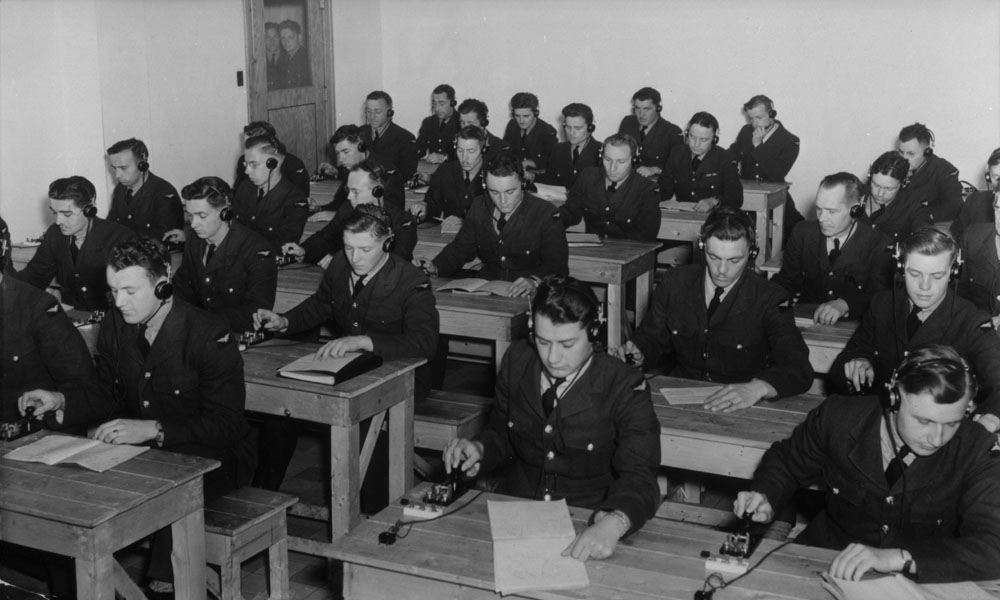
Part of the problem was the protracted negotiations over financial and administrative issues for the British Commonwealth Air Training Plan which were not settled until December 1939. A full year would pass before the rapid expansion of elementary training could begin. By then more than 100,000 Canadians had applied to join the air force.[18] For Montrealers another way of joining the RCAF was instituted in February 1940 when No. 1 Wireless School opened on Queen Mary Road. Intended to accommodate 900 men (women were added in 1942), the school required candidates to have passed their junior matriculation. Courses were conducted in English.[19]
The Royal Canadian Navy was not as popular an option among young men in Montreal, and once members of the voluntary reserve at HMCS Donnacona, the “stone frigate”, meaning a land-based naval command, were called to active duty the remaining reservists, largely overage, struggled to cope with volunteers. The base was split in two with HMCS Montreal for English-language recruits and HMSC Cartier for French Canadians, but the experiment failed to attract French-language volunteers to the most “British” and least bilingual of the three services.[20] It is evident that the words of the army’s official historian C. P. Stacey may be applied to all the services. “The preparations made by Canada before the outbreak of war were so small that she was unable to make any really large contribution to the sum of the Allied war effort for years after the war broke out.”[21]
The isolationists in Cabinet and External Affairs, who had won the battle to prevent Canada from preparing for war, now focused on ways of limiting participation. They were astounded to learn that Ian Mackenzie, the minister of National Defence, interpreted an order-in-council authorizing “the organization of a Canadian Active Service force” as permission to implement Defence Scheme 3, “which included recruiting a two-division corps plus auxiliary units.” According to Grant Dexter, the well-informed Ottawa reporter for the Winnipeg Free Press, “King intervened but it was too late to counteract the order.” Instead the Prime Minister “gave Ian Mackenzie and the general staff hell Wednesday morning and the Department is now instructing militia units everywhere to ease off on enlistments.”[22] None of the city’s militia units paid any attention to the instruction and National Defence continued to develop units for what would become I Canadian Corps.
Defence Scheme No. 3 called for proportional representation of each part of the country with Quebec and the Maritime provinces providing a brigade to each division. The planners also proposed the creation of a French Canadian brigade made up of a battalion from the Royal 22nd and the two best-organized French-language militia regiments the Maisonneuves and Fusiliers Mont-Royal. When the government decided that only one division would be sent overseas, the Royal 22nd was included in the 1st Division to ensure French Canadian representation. No further attempts to group French Canadian units in a brigade were made and, for the balance of the war, the use of French was limited to battalion level.
The Anglo-Celtic militia world was stunned by the decision to ignore their regiments which had played such a large role in the Great War. A delegation from Westmount travelled to Ottawa to plead the case of the Royal Montreal Regiment and it was added to the order of battle as a machine gun battalion. While the Victoria Rifles, Black Watch and Grenadier Guards were left to guard canals in Canada. The “Vics” provided a draft of their young recruits to fill out the ranks of the Three Rivers Regiment.[23]
Major General Andrew McNaughton’s 1st Division could not be fully equipped before it left for England and would have to rely on the British Army to supply what was missing. There was therefore next to nothing left for the 2nd Canadian Division which spent the winter training in impoverished conditions.[24] The Black Watch, with a number of wealthy officers and its own armoury, leased an office building and rooms at the YMCA to serve as barracks. Each morning the men reported to the armoury dressed in kilts. With bagpipes leading the parade they marched to Mount Royal or the McGill campus. There were not enough serviceable boots to permit longer route marches. A request for 200 dummy hand grenades was refused as only 165 had been allocated to the entire Military District. Neither mortars nor the Boys anti-tank rifle was available. By the end of October, the cold weather began and the Ladies Auxiliary was pressed into service to provide mittens and gloves. Three days before Christmas the battalion moved to Toronto’s Exhibition buildings vacated by 1st division units. The men settled into the Horse Palace, four men to a stall. The War Diary reported, “Strep throat raged through the Horse Palace like wildfire at one time more than 400 men were confined to an improvised hospital.”

By March 1940, sufficient battle dress was available to outfit the battalion and the kilt was retired. The War Diary noted that the last time “battle bloomers” were worn in an exercise it was pouring rain so the new uniform was “extremely useful, kilt and tunic in such conditions would have required much repair.” On 26 May the Black Watch returned to Quebec to train at Valcartier, the camp Sam Hughes and friends had built in 1914. Route marches overland were an improvement over city streets but June is a difficult month in the Quebec wilderness; “blackflies, mosquitos, deer flies, hornets havoc” the War Diary reported. Ready access to firing ranges was one advantage to Valcartier but it was soon evident that “the standard arrived at after nine months is not good.”
The battalion’s next stop was Newfoundland where it was tasked with the defence of Gander airport. Men were split into isolated groups and no significant training was possible. Fortunately, Winston Churchill intervened with one of his “action this day” memos. “We require”, he declared, “two Canadian divisions to work as a corps as soon as possible.” On 11 August 1940 the Black Watch left Newfoundland to join the Régiment de Maisonneuve and the Calgary Highlanders in the 5th Canadian Infantry Brigade.
The Maisonneuve’s name had been selected during the militia reorganization of 1920 to perpetuate the 85th. The regiment’s new title honoured the founder of Ville Marie, not the east-end district, and most of its officers came from Outremont and other bourgeois neighbourhoods. A strong military tradition persisted among a number of such families including the Brosseaus who contributed three commanding officers. Family tradition would keep the regiment alive, but in the interwar years the Maisonneuves, who did not possess their own armoury, dealt with their “vagabondage” by using their pay to support summer training and participation in militia sports leagues. The officers won the softball championship eight times while the NCO/other ranked team, always competitive, was victorious in 1938-39.
When the regiment was ordered to raise an active service battalion as part of the 2nd Division, Lieut-Col. Robert Bourassa, a Crown Attorney, prominent in legal circles, was commanding the regiment. Bourassa was taking a course for field officers when the mobilization order arrived. Reaching Montreal, he became involved in a sharp dispute with Military District 4 over the decision to place English-speaking artillery officers in charge of Maisonneuve soldiers posted to guard vital infrastructure.
The quarrel as well as subsequent conflict with the District officers did not interfere with recruiting as more than 2,000 men sought to enlist. Many of these were rejected in a cursory medical exam but the battalion claimed to be the first unit to reach full strength in the entire Canadian army. The recruits slept at home until a large factory building in St. Henri was rented in January 1940. According to Le Devoir, which followed the story of the battalion, the Maisonneuves were denied training space in the Craig Street armoury by “un régiment de langue anglaise” and had to drill in the improvised barracks. Bourassa complained that the men had no boots to train outside and suffered from the unhealthy conditions including cement dust in an unhealed cellar used for accommodations. Conditions did not improve until May 1940 when the battalion was sent to Valcartier. They spent the summer of 1940 in what passed for training in the Canadian Army, as well as guard duty for German prisoners of war arriving at Quebec City. On 24 August the battalion sailed for England.
The Fusiliers Mont-Royal (FMRs) provided the third Montreal battalion to 2nd Division. They had maintained an average of 345 men on strength throughout the depression and with their own armoury were better positioned than the Maisonneuves. A nearby office building was converted into a barracks. Lack of equipment meant training was confined to drills, route marches and trips to Mount Bruno rifle range. The anti-tank platoon learned the theory of firing the anti-tank rifle and two-pounder using pictures of the weapons. After a month at Valcartier, the FMRs were sent to Iceland where the construction of field defences and schemes to protect the island occupied the battalion until they joined 6th Brigade in England.[25]
As the battalions of 2nd Division struggled to cope with training and equipment challenges, the strategic situation was transformed by the retreat of the French army, the Dunkirk evacuation and Mussolini’s declaration of war. Ottawa, “the quietest capital in Christendom… was shocked from complacency.”[26] On 22 May, the one available RCAF squadron was ordered to Britain. The next day four RCN destroyers were sent to join the Royal Navy. National Defence dispatched mobilization orders to units across the country to form 3rd and 4th Canadian Infantry Divisions. This flurry of activity produced modest results in the following twelve months but with defence expenditure rising to 681 million, a five-fold increase over 1939-40, a foundation was being laid.

The city’s newspapers, French and English, used the Canadian Press and other wire services to report on the crisis in Europe with leader writers reflecting editorial bias. Most mass circulation papers supported the King-Lapointe government and its policies with the Gazette and Le Devoir offering criticism from two very different perspectives. The Gazette exhibited its Tory-imperialist credentials in a series of editorials demanding a national coalition government. The Prime Minister, the newspaper claimed, was unfit to lead the nation in a war where Canadians would be fighting alongside their “fellow Britions!”[27]
Le Devoir maintained a low-key anti-participation stance reminding readers that the Americans had restated the Monroe doctrine to include existing European colonies in the western hemisphere and would protect Canada from invasion.[28]
As the French army fell back and the government fled Paris, Montreal newspapers reported on and contributed to the growing hysteria over Fifth Columnists who were said to have aided the German breakthrough in France and would soon be active in Canada. A group of Montreal businessmen formed a “Canadian Column” to counteract internal enemies without having the least idea of what to do.[29]
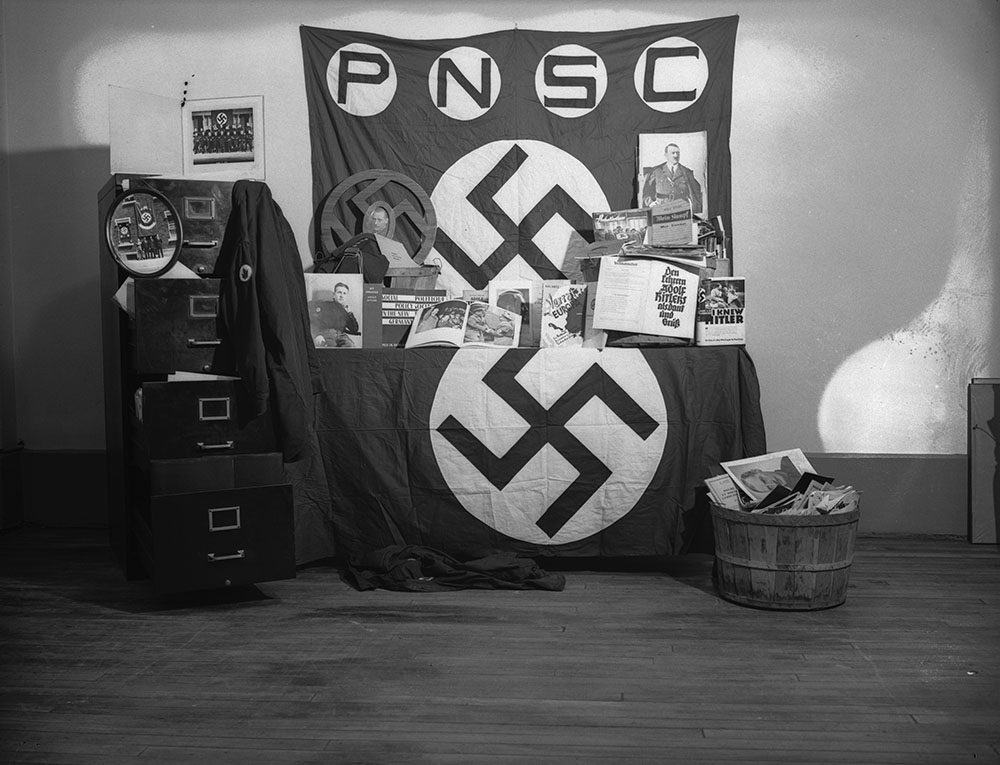
The Cabinet, prompted by the Minister of Justice Ernest Lapointe, decided to outlaw both the Communist Party and Arcand’s National Unity Party, ordaining the arrest of their leaders. When the list of communist front organizations that were also banned was read out in parliament, thunderous applause greeted each name.[30] Saluste Lavery, a prominent nationalist lawyer, sought the release of Arcand and his associates who he described as “the greatest of great Canadians” facing unjust charges “instigated by Jews who are responsible for the war.”[31]
During late May and early June, speculation about an Italian declaration of war competed for space with news of the German advance in France and the Dunkirk evacuation. Lord Halifax, the British Foreign Secretary, and Sir Percy Loraine, the Ambassador in Rome, continued to work to keep Italy out of the war. Building on the Chamberlain- Halifax visit to Mussolini, in January 1939, they tried to maintain the appearance of good relations with Italy, until the last moment.[32] A policy which was endorsed by Canadian authorities.
Mussolini’s declaration of war led Montreal’s Italian consul to call a meeting at the Casa d’Italia where twenty local Italian associations pledged loyalty to Canada and demanded the removal of Mussolini’s portrait from the wall of the Notre Dame de la Défense parish church. The meeting also proposed that the city’s mayor, Camillien Houde, return the decoration received from King Victor Emmanuel.[33] By then the RCMP was implementing an elaborate Canada-wide plan to arrest and intern several hundred Italian Canadians, including naturalized Canadian citizens, on charges of belonging to, or actively participating in, the activities of Fascist organizations linked to Italian consulates. A task force of Mounties, provincial and city police, arrested scores of Montrealers in sudden raids on houses and businesses. Arrangements were made with U.S. authorities to prevent suspects from crossing the border. Censors refused to allow publication of the names of those arrested or the charges. All unnaturalized Italian Canadians were ordered to register, be fingerprinted and agree to obtain permission before changing addresses. According to Le Canada, eighty of the men arrested were sent to a concentration camp without the opportunity to talk to their wives or close relatives, not to mention lawyers.[34] The RCMP justified this arbitrary action against individuals who belonged to legal organizations because of the “volatile nature” of Italians who “can be expected to go to any extreme.”[35]
Montreal’s city council was also ready to participate in this hysteria requiring civic employees to provide a birth certificate or proof of naturalization on pain of dismissal. The Mayor announced that public welfare assistance would be denied to Italian families, estimating that 3,300 men, women and children were on the relief rolls. The city attorney pointed out that the large majority were Canadian citizens and could not legally be denied support.[36] Whether due to self-censorship or agreement with the RCMP’s actions, the Liberal-oriented press reported but did not comment on the treatment of the city’s Italians. The Gazette and Le Devoir were more cautious about using citizens to avoid violence and left potential fifth columnists to the police.
Apart from these comments, which related to a stone-throwing incident at the Italian consulate, Montrealers declined to challenge the extraordinary actions of the government. Both Canadian citizens and resident aliens were charged with participation in organizations which were perfectly legal on 9 June. The Canadian government which supported Britain’s appeasement of Italy had failed to warn Italian Canadians that membership in Fascist associations sponsored by the Italian consuls would be grounds for internment if diplomatic efforts to maintain Italy’s neutrality failed.[37]
News of Mussolini’s action and the internment of Italian Canadians were soon eclipsed by France’s new leader, Phillipe Pétain’s announcement that he would seek an armistice with Hitler rather than lead a revitalized resistance. The city’s English-language media followed the words and actions of Winston Churchill. Pétain was seen as an enemy, and the British decision on 4 July 1940 to bombard the French fleet in the Mediterranean to prevent it from falling into German hands was applauded as evidence of new, decisive leadership. Churchill’s radio broadcasts and the reports of journalists, especially Edward R. Murrow whose program “London Calling” was widely heard, shaped opinion on the future direction of the war.
The defeat of France, Pétain’s acceptance of harsh German armistice terms and the new authoritarian French constitution with the words “Work Family Nation” replacing “Liberty Equality Fraternity” as the national motto, presented politically conscious French Canadians with a serious dilemma. Andre Laurendeau recalled the mood in the city describing:
The dull pain you could read on the faces of Montreal crowds…it was as if the city was in mourning…Everything was lost. Hitler had won. For if France had been vanquished what could Great Britain do? De Gaulle was scarcely listened to…The resistance of the English was judged to be foolhardy. But little by little it stirred up admiration. This was particularly due to the broadcasts of Louis Francœur, a journalist whose influence on public opinion was enormous.[38]
As a young man Louis Francœur joined the Benedictine Order and was in Belgium preparing to take his final vows when the German invasion began in August 1914. Using his status as a monk to travel freely, he compiled information on German atrocities which he made available to British intelligence to be used in the 1915 Brice Report. Francœur left the Benedictines in 1919 spending a decade in Paris as a journalist. Returning to Canada as the depression struck he became a publicist for the Conservative Party and worked for La Patrie before joining Radio Canada in 1939.[39] Francœur, with his memories of the German occupation of Belgium and Northern France, was fully committed to the Allied cause from the outbreak of war. His radio program La querre ce soir began as a weekly series but soon became a daily in response to popular demand.
Laurendeau along with many in Montreal became regular listeners drawn by Francœur’s “admirable erudition and historical knowledge.” Francœur, Laurendeau recalled:
Took us with him into the bombed streets, made us share the nightly anguish of Londoners and admire Churchill’s stubborn stand. And he took us back to France, back to occupied Paris.
Francœur was an open admirer of De Gaulle and the “Free French” movement when most politically conscious French Canadians admired Pétain and his national revolution which Georges Pelletier described as creating, “a France such as we want and wish to see again in our time.”[40] (41) Quebec Liberals were publicly cautious in their support but Lapointe, who knew and admired Pétain, as well as Arthur Cardin and Raoul Dandurand, were opposed to De Gaulle and sympathetic towards Vichy France. Liberal newspapers Le Canada and Le Soleil were unwilling to criticize Pétain’s “revolution” and largely ignored De Gaulle and the Free French movement. When the Vichy government passed its first “Statute of Jews” in October 1940 Le Canada’s editor, Letellier de St. Just, offered a justification:
… lately, particularly during the leadership of Blum, Jews acquired in France an influence prejudicial to the grandeur and tradition of the country. In the civil service, journalism politics and the universities they enjoyed favours and displayed an arrogance which revolted authentic Frenchmen…the present reaction albeit goes too far is only the natural consequence, long foreseen of deplorable excesses.[41]
Measures of lasting significance, which under other circumstances would have provoked debate and conflict among the political classes, were overshadowed by the cascade of war news. The provincial government’s decision to take control of Montreal’s civic administration, appointing a new commission to run the city, was announced in the last days of April during the Anglo-French intervention in Norway. In early May, the invasion of the low countries and then France, the resignation of Neville Chamberlain and the first days of Winston Churchill’s leadership dominated the media and public discussion. Le Devoir and L’illustration Nouvelle criticized the legislation, echoing Maurice Duplessis, but the issue quickly faded.[42]
The second extraordinary measure was the Federal government’s budget for 1940-41. J. L. Ralston told the House of Commons that total expenditure was estimated at 1,118 million dollars with more than half devoted to direct war expenditure. Revenue after receipts from a 350 million dollar tax increase would reach 260 million leaving a deficit of 600 million to be funded from borrowing. This war budget was broadly accepted as what Le Canada described as a necessary sacrifice. The next day Minister of Justice Ernest Lapointe announced that, with the cooperation of all provinces, Canada would seek an amendment to the British North America Act placing unemployment insurance under Federal jurisdiction thus ending a lengthy dispute with Quebec and Ontario.[43] The Union Nationale and Quebec Nationalists complained but given broad popular support, Liberals in Ottawa and Quebec City simply ignored the critics.
Then came the National Resources Mobilization Act (NRMA) which authorized national registration of men and women sixteen to forty-five years of age and introduced conscription of men for service within Canada.[44] Despite considerable unease that conscripts were to serve just thirty days in the military there was little criticism.
André Laurendeau’s comments on his personal decision to register “like everyone else” suggests the confusion and uncertainty that gripped Quebec nationalists. He argued that:
To choose the moment of France’s greatest distress to refuse to collaborate in policies that were intended to avenge her had, it seemed to me, something repugnant about it.
But leaving the registration office he recalls feeling, “I had contradicted and perhaps betrayed myself.” His reaction to the internment of Mayor Camillien Houde, for publicly opposing registration, is similarly contradictory. According to Laurendeau, Houde “was the only one among us to be perfectly logical” but his “empty gesture” could not be supported “because I had lost faith in the value of an isolated act.”[45]
Censorship ought to have prevented the publication of Houde’s statement opposing national registration, but the Montreal Gazette printed it, with editorial comment, in an early edition of the paper, deleting it in later editions on instructions from the censors. The leader of the Opposition, protected by parliamentary immunity, read the Gazette’s story in the House of Commons and Houde’s words quickly became major news. During his last weekend of freedom, Houde tried to rally support calling a special meeting of city council, but Ernest Lapointe was determined to cut off further publicity and ordered immediate internment for violating the Defence of Canada regulation. Houde was arrested as he left his office and taken away in the early hours of the morning.[46] The internment of the city’s colourful Mayor was too good a news story to resist. The Gazette printed a detailed account of the conflict with the censor’s office and defended its actions for several days.[47] (48) With Houde held incommunicado and the city’s aldermen pledging loyalty to the Crown, the story faded away.
Two Montreal regiments were among those selected for 3rd and 4th divisions. The Duke of York’s Hussars joined 3rd Division as the 7th Reconnaissance Regiment, and the Canadian Grenadier Guards became part of 4th Infantry Division. Recruiting began in the fevered atmosphere of June 1940. Neither regiment had any trouble finding volunteers though the Guards’ policy of requiring a minimum height of five feet eight inches meant more time was required to find suitable men.[48] Ironically, height proved a disadvantage when, in February 1942, 4th Division was converted to an armoured division and the Guards became the 22nd Canadian Armoured Regiment.
For both battalions, their first year in khaki was a frustrating experience. No one knew what exactly a reconnaissance or recce regiment was supposed to do but it surely involved light armoured vehicles. None were available so route marches, the rifle range and other basic training as infantry were all that could be accomplished. The Guards had a similar experience but faced the added problem of constant moves, first to Camp Borden, then Valcartier, Halifax and Sussex in New Brunswick. The Regimental history notes a number of volunteers sought to transfer to units that might go overseas sooner thus avoiding more “repetitive training with little real equipment.”[49]
While mobilizing active service battalions for the two new infantry divisions plus eight additional battalions intended for home defence, the army also had to cope with the first cohort of NRMA conscripts. Men between the ages of twenty-one and twenty-four, either single or married with no children, were called up, required to pass a medical exam and report to one of the camps near their home. Ninety-five percent of the first group, 27,599 men reported for their thirty-day training period in October.[50] Fourteen NRMA camps were established in Quebec, five of which were to offer instruction in English. It soon became apparent that much of the province’s eligible English-speaking population was already enrolled in the RCAF or army so two English camps were converted to instruction in French.[51]
Thirty days of training without equipment or weapons beyond Ross Rifles may, as Chief of Staff Major-General Crerar noted, help to create “military mindedness”[52] but its real value was to involve citizens of small communities in the war effort. NRMA camps were built adjacent to Quebec towns like Huntingdon, Sorel, Farnham, Joliette, St. Jerome and Sherbrooke, as well as smaller cities in Eastern Quebec. Cardinal Villeneuve who visited a number of NRMA camps commented that the young conscripts “were enjoying a month’s vacation in the open air with healthy exercise.”[53] A statement made without ironic intent.
Citations
[1] Andre Laurendeau, Witness for Quebec, p. 17
[2] Laurendeau, Witness, p. 18.
[3] Canada, Debates of the House of Common, 10 September 1939.
[4] Conrad Black, Duplessis.
[5] Gipson and Roberts, Grant Dexter, p. 10-11.
[6] Frederick Gibson and Barbara Roberts, (eds) Ottawa at War, The Grant Dexter Memorandum 1939-1945 (Winnipeg 1994), p. 10-11.
[7] Montreal Daily Star, 10 October 1939.
[8] Le Canada, 26 October 1939.
[9] David Lenarcic, “Pragmatism Over Principle: The Canadian Neutrality League, 1938-39” Journal of Canadian Studies, Vol. 29, No. 2 (1994), p. 128-146.
[10] RCMP Security Bulletins 1939-1940
[11] David Rothwell, “United Church Pacifism, October 1939,” The Bulletin No. 22 (Toronto, 1973)
[12] Thomas Socknat, “Witness Against War: Pacifism in Canada 1900-1945,” (PhD Thesis, McMaster University, 1981). online
[13] Canadian Jewish Chronicle, 2 October 1940.
[14] David Ratz, The Canadian Image of Finland 1919-1948 (PhD Thesis, University of Oulu, 2018)
[15] Jean Pariseau and Serge Bernier, French Canadians and Bilingualism in the Canadian Armed Forces Vol 1 (Ottawa, 1998) p. 95.
[16] C. P. Stacey, Six Years of War (Ottawa, 1952) p. 36 online.
[17] W. A. B. Douglas,
[18] Douglas 230 RCAF Assoc.
[19] The operation records books of No 1 Wireless Stations are available with other material at rcaf.info/rcaf-stations/Quebec
[20] “HMCS Donnacona” Canada.ca. See also, David Zimmerman “The Social Background of the Wartime Navy Some Statistical Data” in Michael Hadley et al (eds) A Nations Navy: In Quest of Canadian Naval Identity (Montreal 1993)
[21] Stacey, Six Years, p. 35.
[22] Gipson and Roberts, Grant Dexter, p. 8.
[23] CMHQ Report
[24] The following paragraphs on the Black Watch and Régiment de Maisonneuve are based on the first chapter of my book The Brigade: the Fifth Canadian Infantry Brigade 1939-1945 (Stoney Creek 1992) All quotations are from the War Diaries.
[25] Caroline D’Amours, “Training for Operation Jubilee Tactics and Training in the Fusiliers Mont-Royal and the Dieppe Raid, 1939-1942” Canadian Military History, Vol 22 No. 4 (2015).
[26] Gipson and Roberts, Grant Dexter.
[27] Montreal Gazette, 1 July 1940.
[28] Le Devoir, 5 June 1940.
[29] Montreal Daily Star, 6 June 1940.
[30] New York Times, 6 June 1940.
[31] Le Canada, 11 June 1940; and Canadian Jewish Chronicle, 14 June 1940.
[32] Adam Richardson, “Sir Percy Loraine and British Relations with Italy 1939-1940,” Diplomacy and Statecraft, vol. 31, No. 2 (2020): 257-277.
[33] Le Devoir, 11 June 1940.
[34] Le Canada 12 June 1940. All the daily newspapers reported the news of the internment of the city’s Italian Canadians
[35] RCMP Security Bulletin, 6 May 1940.
[36] Le Patrie, 11 June 1940.
[37] For different views of the actions of the government and the RCMP, see, Franca Iacovetta, Roberto Perin and Angelo Principe Enemies Within: Italian and Other Internees in Canada and Abroad (Toronto 2000)
[38] Laurendeau, Witness, p. 41.
[39] Mathieu Noël, “Une biographie politique et intellectuelle de Louis Francœur” Review of the History French America, Vol. 66, No. 3-4 (2013): 419-439. The late Gilbert Drolet drew my attention to Louis Francœur and offered his collection of the printed pamphlets of La Guerre ce soir. Francœur’s own words reflect his concerns for the Allied cause but there is overt no propaganda in his reporting.
[40] Olivier Courteaux, Canada Between Vichy and Free France (Toronto: 2013), p. 29.
[41] Canadian Jewish Chronicle 23 October 1940. A. M. Klein, the editor of the CJS notes that Le Canada has joined Le Devoir in blaming the Blum administration for the “considerable arrogance of Jews which created a new anti-semitic crisis in France.” It must be noted that La Presse with ten times the circulation of Le Devoir or Le Canada reported the news without such editorial comments.
[42] All newspapers reported the story usually describing the proposed scheme with its unelected councillors from corporate and professional groups as a “Corporatist approach to civic government. See the Montreal Star, 10 May 1940 and Le Devoir, 17 May 1940 for details.
[43] Ruth Roach Pierson, “Gender and Unemployment Debates in Canada 1934-1940” Labour/ Le Travaileur Vol 25, 1990
[44] Daniel Byers, “Mobilizing Canada: The National Defence and Compulsory Military Service in Canada 1940-1945” Canadian Historical Association Journal, Vol 7, No. 1, (1996): 175-203.
[45] Laurendeau, Witness, p. 43-44.
[46] George D. Kerr, “Skirting the Minefield: Press Censorship, Politics and French Canada 1940.” Canadian Journal of Communications, Vol. 8, No. 2, (1982).
[47] Montreal Gazette, 5 August 1940.
[48] William J. Patterson, Soldiers of the Queen: The Canadian Grenadier Guards of Montreal 1899-2009 (Montreal 2009), p. 205.
[49] Patterson, Soldiers of the Queen, p. 212.
[50] Stacey, Six Years, p. 119-120.
[51] Stacey, Six Years, p. 119-120.
[52] Byers, Zombie Army, p. 58.
[53] Montreal Gazette, 1 November 1940.
 Montreal at War
One thought on “Chapter IV: Mobilization”
Comments are closed.